
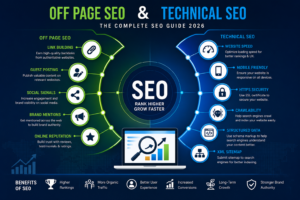
In today’s highly competitive digital landscape, simply launching a website is no longer enough to achieve online success. Every business, blogger, and digital marketer aims to secure a top position on Google, increase organic traffic, and build long-term credibility. To accomplish these goals, mastering Off Page SEO and Technical SEO has become more important than ever. These two essential SEO pillars work together to improve your website’s authority, performance, user experience, and search engine visibility.
While high-quality content remains the backbone of SEO, Google now evaluates websites using hundreds of ranking signals. Factors such as backlink quality, website speed, mobile usability, Core Web Vitals, security, crawlability, and overall technical health directly influence your rankings. This is why businesses that invest in Off Page SEO and Technical SEO consistently outperform competitors in search results.
Whether you’re a beginner, freelancer, business owner, or experienced SEO professional, learning Off Page SEO and Technical SEO can help you build sustainable rankings, attract targeted visitors, and increase conversions. At Deepcrafte, we believe SEO is more than just ranking higher—it’s about building trust, delivering exceptional user experiences, and creating a website that both users and search engines love.
What is SEO?
Search Engine Optimization (SEO) is the process of improving a website’s visibility in search engines like Google, Bing, and Yahoo. The primary objective of SEO is to attract high-quality organic traffic without relying solely on paid advertisements.
Modern SEO consists of three major components:
- On-Page SEO – Optimizing website content, headings, images, keywords, and user experience.
- Off Page SEO – Building authority and trust through backlinks, digital PR, social signals, and brand mentions.
- Technical SEO – Improving website architecture, speed, indexing, crawlability, security, and overall technical performance.
A successful digital marketing strategy requires balancing all three areas. However, Off Page SEO and Technical SEO often have the greatest long-term impact because they strengthen your website’s authority while ensuring search engines can efficiently crawl and index every important page.
Why Off Page SEO and Technical SEO Matter in 2026
Google’s search algorithms continue to evolve every year. In 2026, artificial intelligence, machine learning, and user experience play a much larger role in determining search rankings than ever before. Websites that focus only on content creation while ignoring Off Page SEO and Technical SEO often struggle to compete against well-optimized competitors.
Here are some of the biggest advantages of implementing Off Page SEO and Technical SEO effectively:
- Higher organic search rankings
- Increased website authority and trust
- Faster crawling and indexing
- Better Core Web Vitals performance
- Improved website security
- Enhanced mobile user experience
- More qualified organic traffic
- Higher conversion rates
- Stronger brand credibility
- Sustainable long-term SEO growth
Businesses that consistently invest in Off Page SEO and Technical SEO build stronger online visibility and are better prepared for future Google algorithm updates.
What is Off Page SEO?
Off Page SEO refers to all optimization activities performed outside your own website to improve its authority, credibility, and search engine rankings. Unlike On-Page SEO, which focuses on optimizing content within your website, Off Page SEO helps search engines evaluate how trustworthy and valuable your website is based on external signals.
Google considers these external signals as votes of confidence. The more high-quality recommendations your website receives from reputable sources, the more likely it is to rank higher in search results.
Some of the most effective Off Page SEO techniques include:
- High-quality backlink building
- Guest posting
- Digital PR campaigns
- Social media engagement
- Brand mentions
- Influencer collaborations
- Local citations
- Online reviews
- Content marketing
- Community participation
A strong Off Page SEO and Technical SEO strategy ensures that your website not only gains authority but also maintains excellent technical performance for sustainable growth.
Why Off Page SEO is Important
Search engines don’t rank websites based only on content quality. They also evaluate how other websites and users interact with your brand. This makes Off Page SEO one of the strongest indicators of authority and trustworthiness.
Google considers several external ranking signals, including:
- Website authority
- Domain reputation
- High-quality backlinks
- Brand popularity
- User trust
- Industry recognition
- Online reviews
- Social engagement
- Topical relevance
When these signals are combined with strong Off Page SEO and Technical SEO, your website gains a competitive advantage that is difficult for competitors to replicate.
Top Off Page SEO Techniques (2026)
1. High-Quality Link Building
Backlinks remain one of Google’s most powerful ranking factors. However, quality always matters more than quantity.
Focus on earning backlinks from:
- High-authority blogs
- Industry-leading websites
- News publications
- Educational institutions
- Government websites
- Trusted business directories
- Relevant niche websites
Avoid purchasing low-quality backlinks, as they can negatively impact your website’s rankings.
2. Guest Posting
Guest posting continues to be one of the safest and most effective Off Page SEO techniques. Publishing informative articles on reputable websites helps you:
- Build website authority
- Earn natural backlinks
- Increase referral traffic
- Reach new audiences
- Strengthen brand awareness
Always prioritize quality over quantity and contribute genuinely helpful content.
Different Types of Posting in Off Page SEO
Posting is one of the most effective strategies in Off Page SEO and Technical SEO because it helps improve your website’s authority, generate quality backlinks, and increase brand visibility. Different types of posting allow you to reach new audiences while building trust with search engines. Some of the most popular posting methods include Guest Posting, where you publish articles on other websites; Profile Creation Posting, which creates backlinks through business profiles; Forum Posting, where you answer questions in niche communities; Blog Commenting, which encourages engagement on relevant blogs; Social Media Posting, which boosts content visibility; Question & Answer Posting on platforms like Quora; Directory Submission for business listings; Classified Posting to promote services; and Press Release Posting for sharing company news. When done naturally and on high-quality websites, these posting techniques strengthen your Off Page SEO and Technical SEO strategy and contribute to sustainable search engine rankings.
Technical SEO: The Complete Guide to Improve Website Performance (2026)
Technical SEO is one of the most important pillars of Off Page SEO and Technical SEO because it ensures that search engines can crawl, index, and understand your website efficiently. Even if you create outstanding content and build high-quality backlinks, your website may struggle to rank if technical issues prevent search engines from accessing your pages. Google now prioritizes websites that offer fast loading speeds, excellent mobile experiences, secure connections, and a well-structured architecture. By implementing Off Page SEO and Technical SEO together, you create a website that is both authoritative and technically optimized, leading to better rankings, improved user experience, and long-term organic growth.
Why Technical SEO is Important
Technical SEO focuses on improving your website’s infrastructure so that search engines can easily discover, crawl, and index your content. A technically optimized website provides a better experience for both users and search engines, making it an essential part of Off Page SEO and Technical SEO.
Some key benefits of Technical SEO include:
- Faster website crawling and indexing
- Better Google rankings
- Improved Core Web Vitals
- Enhanced website security
- Higher mobile usability
- Lower bounce rate
- Better user experience
- Increased organic traffic
- Improved website performance
- Long-term SEO stability
Without proper Technical SEO, even the strongest Off Page SEO and Technical SEO strategy cannot deliver consistent results.
1. Website Crawlability
Crawlability refers to how easily search engine bots like Googlebot can access and scan your website. If Google cannot crawl your pages, they cannot appear in search results.
To improve crawlability:
- Maintain a clean website structure.
- Fix broken links (404 errors).
- Avoid unnecessary redirect chains.
- Create logical internal linking.
- Remove orphan pages.
- Keep navigation simple and user-friendly.
A crawl-friendly website is one of the strongest foundations of Off Page SEO and Technical SEO, helping Google discover new pages quickly and index them correctly.
2. XML Sitemap
An XML Sitemap acts as a roadmap that tells search engines about all the important pages on your website. It helps Google understand your website structure and discover newly published content more efficiently.
An XML Sitemap includes:
- Blog posts
- Landing pages
- Product pages
- Category pages
- Service pages
Always submit your sitemap through Google Search Console and update it regularly. A properly configured XML Sitemap supports both Technical SEO and the overall success of your Off Page SEO and Technical SEO strategy.
3. Robots.txt File
The Robots.txt file instructs search engine crawlers which sections of your website should or should not be accessed. Proper configuration prevents unnecessary pages from being crawled while allowing important content to remain visible.
Common pages blocked using Robots.txt include:
- Admin dashboard
- Login pages
- Test environments
- Internal search results
- Duplicate content sections
Be careful not to block valuable pages accidentally, as this can negatively impact your Off Page SEO and Technical SEO performance.
4. Website Speed Optimization
Website speed is one of Google’s confirmed ranking factors. A slow-loading website frustrates users, increases bounce rates, and reduces conversions.
Improve website speed by:
- Compressing images using WebP or AVIF formats.
- Enabling browser caching.
- Using a Content Delivery Network (CDN).
- Minifying CSS, JavaScript, and HTML.
- Removing unused plugins and scripts.
- Implementing lazy loading for images and videos.
- Choosing high-performance web hosting.
A loading speed below two seconds provides an excellent user experience and strengthens your Off Page SEO and Technical SEO efforts.
5. Core Web Vitals
Core Web Vitals are Google’s user experience metrics that measure how visitors interact with your website. Optimizing these metrics improves both rankings and usability.
Largest Contentful Paint (LCP)
Measures how quickly the main content loads.
Recommended Target: Under 2.5 seconds.
Interaction to Next Paint (INP)
Measures how responsive your website feels when users interact with it.
Recommended Target: Under 200 milliseconds.
Cumulative Layout Shift (CLS)
Measures unexpected movement of page elements during loading.
Recommended Target: Less than 0.1.
Good Core Web Vitals scores are now essential for successful Off Page SEO and Technical SEO optimization.
6. Mobile SEO
Google follows a Mobile-First Indexing approach, meaning it primarily evaluates the mobile version of your website before determining rankings.
A mobile-friendly website should have:
- Responsive design
- Readable fonts
- Fast loading speed
- Easy navigation
- Proper button spacing
- Optimized images
- No horizontal scrolling
Since most users access websites through smartphones, mobile optimization has become a critical part of Off Page SEO and Technical SEO.
7. HTTPS Security
Website security directly affects user trust and search rankings. Every website should use HTTPS with a valid SSL certificate to encrypt communication between users and servers.
Benefits of HTTPS include:
- Secure data transmission
- Improved trustworthiness
- Browser security indicators
- Better search engine rankings
- Protection against cyber threats
HTTPS has become a standard requirement for effective Off Page SEO and Technical SEO.
8. Structured Data (Schema Markup)
Schema Markup helps search engines understand your content more accurately. It also enables rich results that improve visibility and click-through rates.
Popular schema types include:
- Article Schema
- FAQ Schema
- Product Schema
- Review Schema
- Breadcrumb Schema
- Organization Schema
- Local Business Schema
Implementing structured data enhances both Technical SEO and your overall Off Page SEO and Technical SEO strategy.
9. Canonical Tags
Canonical tags help search engines identify the preferred version of duplicate or similar pages. They consolidate ranking signals and prevent duplicate content issues.
Canonical tags are especially useful for:
- Product variations
- Filtered URLs
- Tracking parameters
- Paginated pages
Proper canonical implementation improves crawl efficiency and supports a healthy Off Page SEO and Technical SEO framework.
10. Indexing Optimization
Indexing determines which pages appear in Google Search results. Not every page on your website needs to be indexed.
Pages to Index:
- Blog posts
- Landing pages
- Product pages
- Category pages
- Service pages
Pages to Noindex:
- Thank-you pages
- Login pages
- Admin pages
- Internal search pages
Regularly monitor indexing status through Google Search Console to ensure your most valuable pages remain visible.
Technical SEO Checklist (2026)
Before publishing or auditing your website, verify the following:
- ✔ HTTPS enabled
- ✔ XML Sitemap submitted
- ✔ Robots.txt configured correctly
- ✔ Fast loading speed
- ✔ Mobile-friendly design
- ✔ Core Web Vitals optimized
- ✔ Structured Data implemented
- ✔ Canonical tags configured
- ✔ Clean URL structure
- ✔ Optimized images
- ✔ Broken links fixed
- ✔ Proper internal linking
- ✔ Crawl errors resolved
- ✔ Duplicate content eliminated
- ✔ Google Search Console connected
Following this checklist ensures your website remains technically healthy and strengthens your Off Page SEO and Technical SEO performance.
Best SEO Learning Roadmap (2026)
Learning Off Page SEO and Technical SEO is one of the smartest investments for anyone who wants to build a successful career in digital marketing. Whether you’re a blogger, freelancer, business owner, or SEO executive, understanding the fundamentals and advanced concepts of Off Page SEO and Technical SEO will help you improve website rankings, increase organic traffic, and build long-term online authority. Instead of trying to learn everything at once, follow a structured roadmap that gradually builds your knowledge and practical skills.
Step 1: Learn SEO Fundamentals
Start by understanding how search engines like Google work. Learn the basics of crawling, indexing, ranking, and search intent. Once you understand these concepts, it becomes easier to implement Off Page SEO and Technical SEO strategies effectively.
Topics to learn include:
- Search Engine Basics
- Keyword Research
- Search Intent
- On-Page SEO
- Off Page SEO
- Technical SEO
- Google Ranking Factors
A strong foundation makes advanced SEO much easier to understand.
Step 2: Master Keyword Research
Keyword research is the backbone of every SEO strategy. Before writing content, identify what users are searching for and understand their intent.
Important keyword types include:
- Short-Tail Keywords
- Long-Tail Keywords
- Informational Keywords
- Commercial Keywords
- Transactional Keywords
- Local SEO Keywords
Use keyword research naturally while implementing Off Page SEO and Technical SEO techniques to attract targeted visitors.
Step 3: Learn On-Page SEO
Before focusing on Off Page SEO and Technical SEO, every SEO learner should master On-Page SEO.
Optimize:
- SEO Title
- Meta Description
- URL Structure
- Heading Tags (H1–H6)
- Image Alt Text
- Internal Linking
- Content Readability
- Keyword Placement
Good On-Page SEO creates a solid foundation for successful Off-Page and Technical optimization.
Step 4: Master Technical SEO
Technical SEO ensures your website performs efficiently for both users and search engines.
Important Technical SEO topics include:
- Website Speed
- Core Web Vitals
- Mobile SEO
- HTTPS
- XML Sitemap
- Robots.txt
- Schema Markup
- Canonical Tags
- Crawlability
- Indexing
A technically optimized website improves the effectiveness of your Off Page SEO and Technical SEO strategy.
Step 5: Learn Advanced Off Page SEO
Advanced Off Page SEO and Technical SEO focuses on building authority and trust through ethical optimization techniques.
Key strategies include:
- Guest Posting
- Digital PR
- Quality Link Building
- Brand Mentions
- Influencer Outreach
- Podcast Marketing
- Business Citations
- Community Engagement
- Social Media Promotion
Remember, quality always outweighs quantity when building backlinks.
Latest SEO Trends in 2026
Google continues to improve its algorithms every year. Staying updated with the latest trends helps maintain rankings and future-proofs your SEO strategy.
AI-Powered Search
Artificial Intelligence now understands user intent better than ever before. Websites offering genuinely helpful and original content are more likely to rank.
EEAT Optimization
Google rewards websites that demonstrate:
- Experience
- Expertise
- Authoritativeness
- Trustworthiness
Adding author profiles, reliable information, and accurate content strengthens Off Page SEO and Technical SEO performance.
Voice Search Optimization
More users now search using voice assistants. Write conversational content that answers real user questions.
Video SEO
Optimizing YouTube videos, transcripts, thumbnails, and video schema can increase search visibility.
Local SEO Growth
Businesses should optimize Google Business Profiles, encourage authentic reviews, and maintain consistent local citations.
Essential SEO Tips (2026)
Follow these practical tips to improve your Off Page SEO and Technical SEO strategy:
- Publish original and valuable content regularly.
- Focus on user intent instead of keyword stuffing.
- Build natural backlinks from authoritative websites.
- Improve website loading speed.
- Optimize images before uploading.
- Keep your website mobile-friendly.
- Update old articles frequently.
- Monitor website performance using Google Search Console and Analytics.
- Perform regular Technical SEO audits.
- Follow Google’s Helpful Content guidelines.
SEO is a long-term process, and consistency is the key to sustainable success.
Common SEO Mistakes to Avoid
Many websites lose rankings because of avoidable SEO mistakes. Preventing these errors strengthens your Off Page SEO and Technical SEO efforts.
Avoid:
- Keyword Stuffing
- Buying Spam Backlinks
- Duplicate Content
- Broken Internal Links
- Slow Website Speed
- Ignoring Mobile Optimization
- Missing Meta Tags
- Poor URL Structure
- Thin Content
- Ignoring Technical SEO Audits
Regular monitoring and updates keep your website healthy and competitive.
Why Choose Deepcrafte?
At Deepcrafte, we believe that successful SEO is built on strategy, consistency, and ethical optimization. Our team specializes in helping businesses improve their online presence through modern Off Page SEO and Technical SEO techniques that align with Google’s latest guidelines. We focus on creating sustainable growth rather than relying on shortcuts or outdated practices.
Our SEO services include:
- SEO Strategy Planning
- Keyword Research
- On-Page SEO Optimization
- Off Page SEO Campaigns
- Technical SEO Audits
- Website Speed Optimization
- Schema Markup Implementation
- Core Web Vitals Optimization
- Local SEO
- Content Optimization
- Monthly SEO Reporting
Whether you’re a startup, blogger, eCommerce business, or enterprise, Deepcrafte provides customized SEO solutions designed to increase visibility, organic traffic, and conversions.
Conclusion
Building a successful website in 2026 requires more than just publishing quality content. Search engines now evaluate website authority, user experience, technical performance, and trust signals before deciding where a page should rank. By combining Off Page SEO and Technical SEO, you create a strong foundation that improves search visibility, enhances user experience, and delivers long-term organic growth.
From earning high-quality backlinks and improving website authority to optimizing Core Web Vitals, mobile usability, crawlability, and structured data, every aspect of Off Page SEO and Technical SEO contributes to better rankings. If you consistently apply these best practices, monitor performance, and adapt to Google’s evolving algorithms, your website will be well-positioned for long-term success.
At Deepcrafte, we are committed to helping businesses and individuals master Off Page SEO and Technical SEO with proven strategies, ethical practices, and future-ready optimization techniques that drive measurable results.
Frequently Asked Questions (FAQs)
1. What is Off Page SEO and Technical SEO?
Off Page SEO and Technical SEO combines authority-building techniques like backlinks, guest posting, and brand mentions with technical improvements such as website speed, crawlability, indexing, XML Sitemaps, and Core Web Vitals to improve search rankings.
2. Why is Off Page SEO and Technical SEO important?
It improves website authority, user experience, technical performance, and search engine visibility, helping websites achieve higher Google rankings and long-term organic traffic.
3. How long does Off Page SEO and Technical SEO take to show results?
SEO is a long-term strategy. Depending on your competition and website quality, noticeable improvements often appear within several months of consistent optimization.
4. Are backlinks still important in 2026?
Yes. High-quality, relevant backlinks remain one of the strongest ranking signals. They work best when combined with a technically optimized website.
5. Which tools are useful for learning SEO?
Popular tools include Google Search Console, Google Analytics 4, Google PageSpeed Insights, Google Lighthouse, Bing Webmaster Tools, Ahrefs, SEMrush, and Screaming Frog SEO Spider.
6. How often should I perform a Technical SEO audit?
A full audit every three to six months is recommended, along with continuous monitoring of crawl errors, indexing issues, and Core Web Vitals.
7. Can beginners learn Off Page SEO and Technical SEO without coding?
Yes. Beginners can learn the fundamentals without coding knowledge. However, understanding basic HTML, CSS, and website structure is beneficial for advanced Technical SEO and troubleshooting.